

5 Survey Design Traps That Kill Online Survey Respondent Motivation in China
2026/04/30
Table of Contents
Introduction
Conducting online surveys in China presents a distinct set of challenges for international researchers. Respondent expectations and behavioral patterns can differ significantly from other markets — and these differences have a direct impact on respondents’ engagement, and hence data quality.
This article draws on data collected directly from Chinese online survey respondents to examine the factors that undermine participation motivation, and covers five common survey design traps that lead to dropout or hesitation among Chinese respondents. By listening to the respondent perspective, researchers can design studies that are not only more engaging, but more likely to yield high-quality data.
Key Takeaways
- Nearly half of Chinese survey respondents (48.8%) have abandoned a survey before completing it
- 81.1% of Chinese survey respondents may not sustain concentration beyond 20 minutes
- Points and electronic money are the most preferred incentive type among Chinese respondents (78%)
- Audio evaluation questions were the least preferred survey format, with only 56.8% willing to engage
- UI and technical issues account for over 35% of survey abandonment — independent of content quality
|
For online research in Asia, learn how GMO Research & AI's online panel supports your needs. |
Respondent Profile
This analysis is based on responses from 577 participants from GMO Research & AI’s online survey panel in China. The sample was composed of active panel members with established survey experience: 53.6% had completed more than 50 surveys, and 55.6% participate nearly every day. This reflects the profile of respondents researchers are most likely to encounter when fielding studies through established panels in China.
In terms of demographics, the sample was 53.2% male and 46.8% female, spanning three generational cohorts: Gen Z (31.9%), Millennials (42.8%), and Gen X (24.4%).
5 Reasons Your China Survey May Be Losing Respondents
Why Chinese Survey Respondents Drop Out: The Data Behind Participation Hesitation
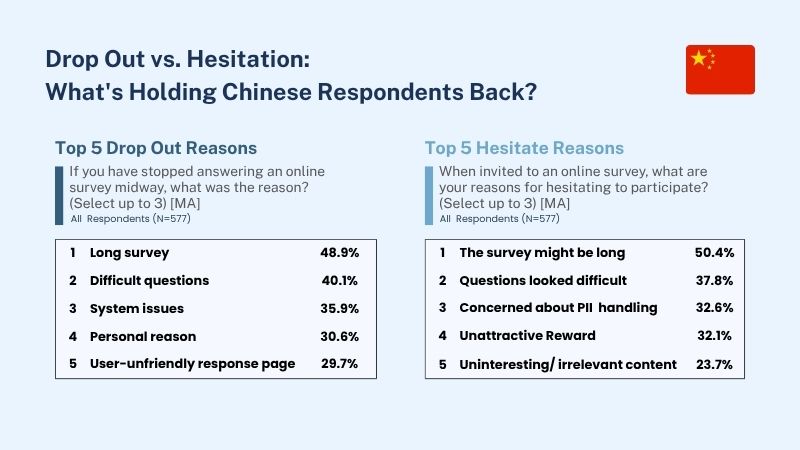
The scale of the problem is significant. Most respondents (82.1%) reported experience of abandoning a survey before completing it, and a substantial share hesitate before deciding to participate at all.
When examining the reasons behind both behaviors, a clear pattern emerges. The factors that cause respondents to quit mid-survey and those that prevent them from starting share considerable overlap — pointing to a consistent set of design issues that affect motivation at every stage of participation.
*Click on the image to expand
The following traps represent the most prominent of these issues.
Trap 1: Survey Length — How Long Is Too Long in China?
Length is the most consistent motivation killer — affecting both initial participation and completion. "Too many questions" was the top reason respondents cited for abandoning a survey mid-way (48.9%), while "looks too long" was the leading reason for hesitating to start (50.4%).
Regarding the threshold for "long" surveys, respondents were asked about their concentration limits: 28.1% cited 15 to 20 minutes, while 27.2% identified the 10 to 20-minute range as the maximum duration they can remain focused.
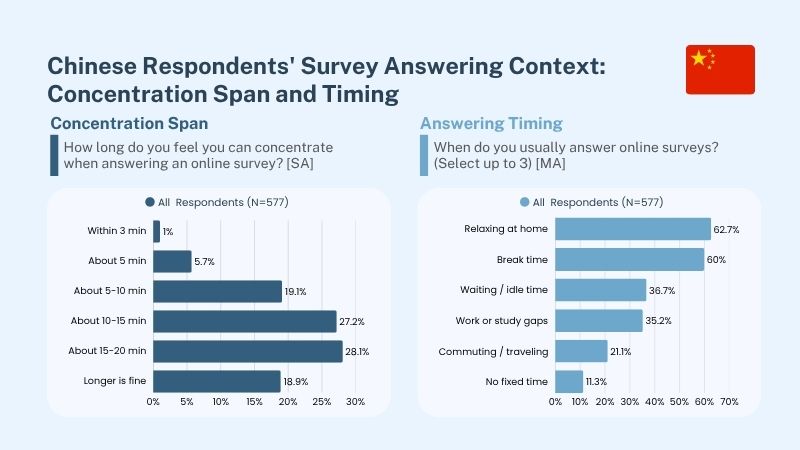
Furthermore, considering where respondents are actually completing surveys, the most common settings are relaxing at home (62.7%) and during lunch or short breaks (60.0%), where sustained concentration is not always possible.
Researchers who design beyond these limits risk increased dropout and lower motivation among respondents.
Trap 2: Survey Difficulty — Why Complexity Hurts in China
Perceived difficulty was the second most cited reason for both dropping out (40.1%) and hesitating to participate (37.8%). To define what "difficult" means in this context, understanding what Chinese respondents are expecting is crucial.
Beyond financial incentives, top reasons for participation are making good use of free time (47.7%), enjoying the act of answering (44.2%), and being able to respond to topics they find personally relevant (43.2%). These motivations suggest surveys must be accessible and engaging rather than cognitively demanding.
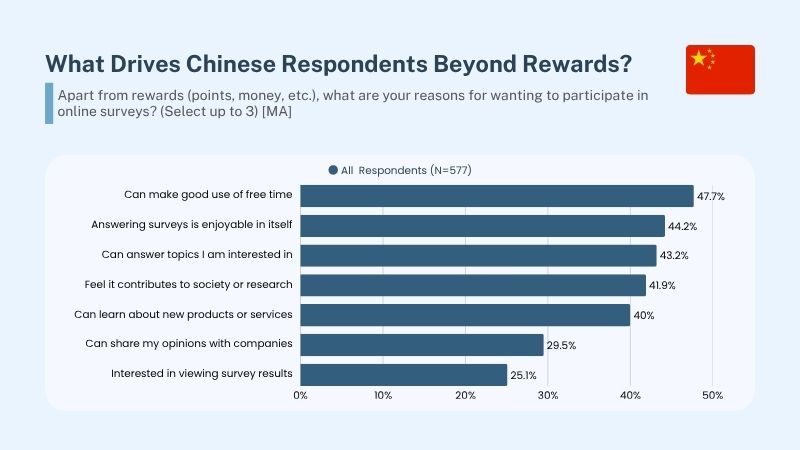
Complexity—including sustained mental effort, jargon, or difficult comparisons—creates friction with respondents’ expectations. Effective design in this context means crafting an experience that feels natural and lightweight, not merely simplifying individual questions.
Trap 3: Incentive Design — Getting Rewards Right in China
Incentives are a critical factor in the participation decision. Reward ranked as the top consideration when deciding whether to participate for 25% of respondents, and "unattractive reward" was cited by 32.1% as a reason for hesitation. Getting incentives right matters — but the data suggests that the type of reward may matter as much as the value.
Points and electronic money were the most preferred reward type overall (78.0%), making them the most reliable incentive choice regardless of target demographic. Beyond that, product samples (49.4%) and gift vouchers (47.1%) also show meaningful appeal — but with important caveats. Gift vouchers in particular reveal a striking generational divide: 59.9% of Millennials and 47.5% of Gen X find them appealing, compared to just 29.9% among Gen Z. Offering the same incentive across age groups risks a mismatch that can quietly suppress participation.
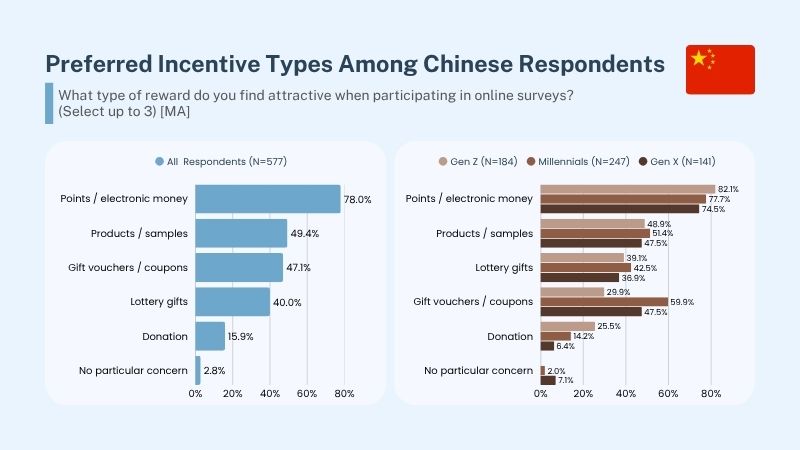
Understanding the generational profile of your target sample is a practical starting point for designing incentives that align with respondent expectations — demonstrating respect for participants' time and reducing the risk of avoidable drops in participation rates.
Trap 4: UI and Technical Failures in China Surveys
Technical and usability failures represent a meaningful but often underestimated source of survey abandonment. "Connectivity or system issues" was the third most cited reason for dropping out (35.9%), and "the response page was hard to use" followed at 29.7%. Feedback from participants highlighted specific technical frustrations. In open-ended responses, some noting that "the response page contained bugs". Others reported that "questions repeated themselves, making it impossible to finish the survey," ultimately leaving them with "no choice but to exit the page".
These factors drive significant dropout rates and are independent of survey design quality. Mobile-first and technically reliable survey delivery is a baseline requirement in the Chinese market, not an enhancement.
Trap 5: Audio and Video Questions in China's Mobile Survey Environment
Audio and video question formats present an additional but often overlooked risk to respondent motivation. Preference data reveals a meaningful resistance: audio evaluation questions ranked last among all survey formats, with only 56.8% of respondents willing to engage with them. Video evaluation came in next at 72.3%. However, a demographic breakdown shows that willingness to participate drops further among specific groups, with only 63.0% of Generation Z and 69.5% of Generation X expressing a desire to respond.
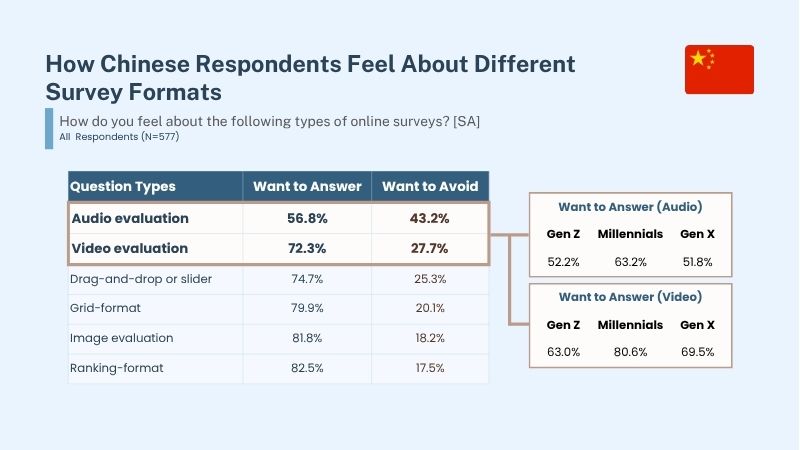
The most plausible explanation lies in the answering context. Given that a significant proportion of respondents complete surveys during breaks or in shared environments, formats that require sound output and consuming additional mobile data might be structurally incompatible with common answering situations. If audio or video stimuli are necessary, researchers should provide upfront clarity, minimize media length, and evaluate if alternative formats could achieve the same objectives.
Designing Better Surveys for the Chinese Market
Across all five traps, a consistent picture emerges: Chinese respondents expect surveys that respect their time, fit their environment, and offer meaningful incentives. Understanding these expectations is a practical foundation for designing studies that engage respondents more effectively — and ultimately yield more reliable data.
GMO Research & AI will continue to gather voices from panelists across Asia, providing the market research industry with the market-specific insights needed to design better studies across the region.
Survey Specifications
Survey Date: Apr 13-15, 2026
Method: Online survey
Target Group: Panelists participated in online surveys for more that 10 times
Region: China
Sample Size: 577
Conducted by: GMO Research & AI
For a full picture and detailed survey results,
please feel free to download the tabulated data.
.png?height=46&width=250)
Interested in learning how to succeed with your survey projects in APAC?
Find out more from our previous contents!
Find out more from our previous contents!
 |
Reviewed by: Yukiya Nagata
Executive Managing Director of GMO Research & AI
|
Joined GMO Research & AI in 2011, Yukiya was the domestic sales director of the Japan headquarter until 2016. He then shifted to a new role of managing the global panel and developed online research services in South-East Asia. He also launched the Malaysia office, operating the company as a managing director until 2021. As a board member, his current role involves seeking new business opportunities and partners worldwide.

