

Navigating B2B Market Research in South Korea: Understanding Respondent Attitudes and Engagement Strategies
2026/09/24
B2B research is challenging as collecting precise responses is not always easy, especially when respondents are answering from the point of view of their company and the topics in the questionnaires sound sensitive. This study explores how business professionals in South Korea navigate B2B market research, examining participation willingness, corporate compliance constraints, and preferred research methodologies. Based on insights from 224 predominantly managerial respondents, the data highlights key privacy barriers, how confidentiality rules alter response behavior based on prior survey experience, and the crucial conditions needed to ensure data security and drive higher engagement.
|
For online research in Asia, learn how GMO Research & AI's online panel supports your needs. |
Respondent Profile:
The 224 respondents were employed professionals in Korea, weighted toward senior roles.
- Position: 14.3% executives or board members, 27.7% department or division heads, 47.3% managers, and 7.1% team leaders or supervisors, plus 3.6% specialists — almost 90% in managerial roles.
- Company size: mid-to-large, roughly 45.5% of organizations with 50-500 employees, 35.3% at organizations from 501-10,000 employees, and about 4% of more than 10,000 employees ; small size companies are 15.2%.
- Experience: only 28.1% (63 of 224) had taken part in B2B research before; the remaining of 71.9% (N=161) had none.
Korean Respondents' Overall Willingness Toward B2B Research
We asked respondents how willing they were to participate in B2B market research, with 44.6% willing or very willing and 35.7% somewhat willing, a notable 19.6% remaining hesitant or unwilling.
There are a few main reasons for holding respondents from taking part in a B2B survey:
- 41.1% - Concerned about whether their personal information will be properly managed
- 38.8% - Concerned the survey will take too long
- 29% - Worried about receiving unsolicited emails or calls after participating
- 22.8% - Questions seem too difficult or specialized
- 22.3% - Reward or incentive is insufficient
Corporate Compliance and Confidentiality Constraints
Workplace rules regarding corporate secrets and information disclosure significantly influence how professionals handle sensitive B2B topics.
Company Rules and Internal Restrictions
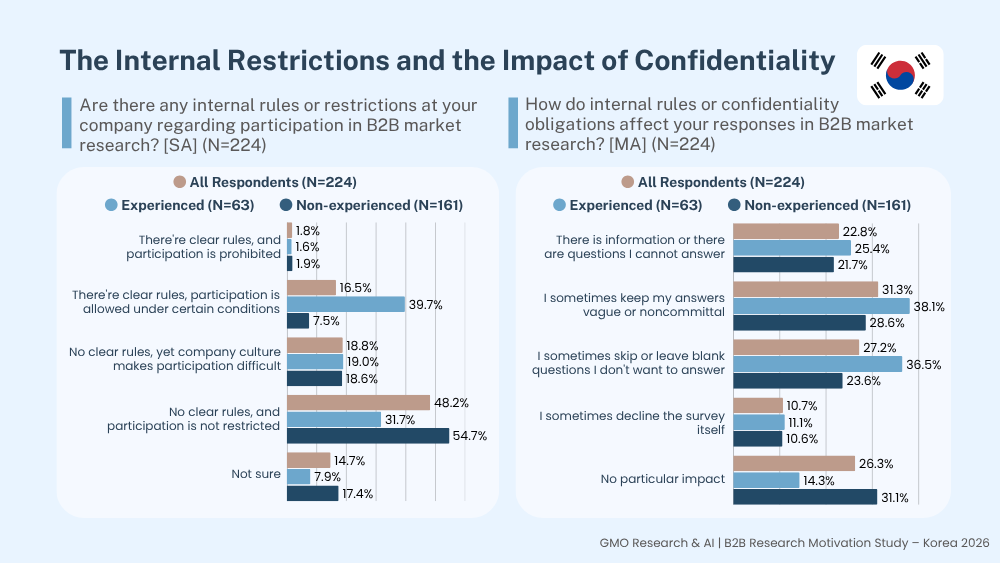
Based on survey data from 224 respondents, nearly half (48.2%) report having no clear internal rules or restrictions regarding research participation, whereas only (1.8%) report strict, total prohibitions. 14.7% answered that they are not sure. However, a closer look at the data highlights a major divide in policy awareness and structure between experienced and non-experienced participants.
About 39.7% of experienced respondents declared that there are clear rules and participation is allowed under certain conditions, while 31.7% expressed that there are no clear rules and participation is unrestricted. Only 7.9% stated that they are unsure.
On the other hand, approximately 54.7% of non-experienced respondents mention there are no clear rules and participation is not restricted, and 17.4% are unsure about the rules.
Impact of Confidentiality Obligations on Response Behavior
Confidentiality obligations actively shape how respondents engage with questions: 31.3% of all respondents keep answers vague or noncommittal, and 27.2% skip questions entirely.
Another key takeaway is that 26.3% of the overall selected the 'no particular impact' option, but proportion differences could be observed between the experienced and non-experience segment. 14.3% and 31.3% respectively think that there are “no particular impacts.”
* Click on the image to expand
Perceived Range of Answerable Topics
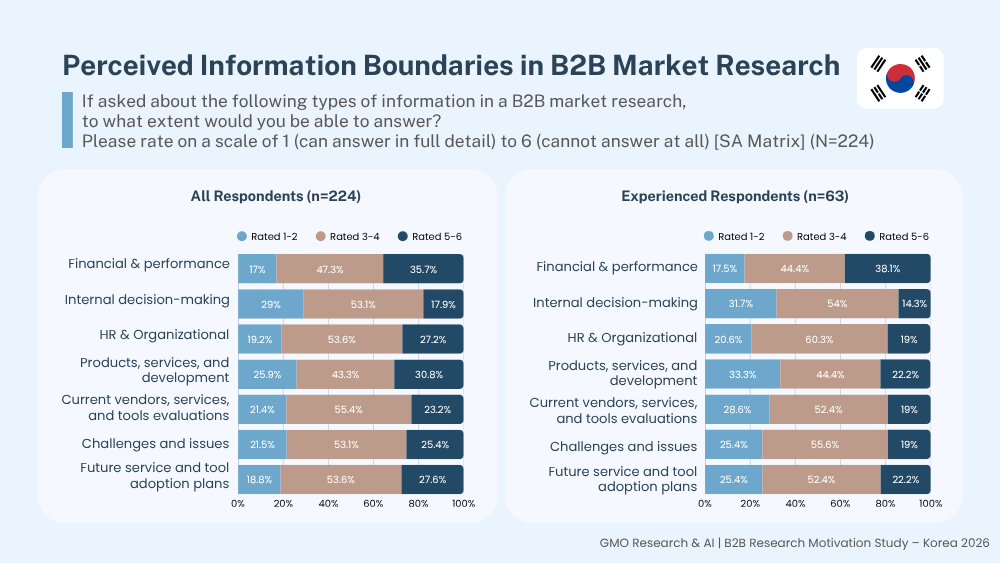
When evaluating their willingness to disclose corporate information, respondents were asked how detailed their answers could be across seven topics, including financial and performance, internal decision-making, organizational information, product development, evaluation of services currently used, company issues and future plans. Responses were measured on a scale of 1–6, where 1 stands for “Can answer in detail” and 6 stands for “ Cannot answer at all”.
Overall, respondents most frequently adopted a neutral position (scales 3–4), accounting for roughly 43–53% of responses across topics, whereas expressing varying degrees of hesitation depending on the subject matter.
When assessing whether to share specific information across almost all categories, respondents draw clear boundaries based on their own personal experience. When comparing respondents who are more able to answer in detail (rated 1 to 2) and those who are more conservative or cannot answer at all (rated 5 to 6), the data shows that the latter group is larger for six over seven topics, ranging from 18-36%. This implies that respondents may tend to be more conservative when answering B2B related questions in the overall trend.
The percentage comparison of the two groups across the seven topics are displayed below:
- Company financial & performance - 17% (respondents rating 1 to 2) vs. 35.7% (respondents rating 5 to 6)
- Internal decision-making processes - 29% vs. 17.9%
- Products, services, and development information - 25.9% vs. 30.8%
- HR and organizational information - 19.2% vs. 27.2%
- Company's future plans for service or tool adoption - 18.8% vs. 27.6%
- Company challenges and issues - 21.5% vs. 25.4%
- Evaluation of services, tools, and vendors currently used by the company - 21.4% vs. 23.3%
In contrast, when looking into respondents with B2B participation experience, approximately 21-33% consistently rating their ability to share detailed feedback (selected 1 to 2), this demonstrates a stronger willingness to disclose more information, compared to the proportion who cannot answer at all (selected 5 to 6).
Comparison of the two groups (those who selected 1 to 2 or 5 to 6) within the experienced segment are displayed below.
- Company financial and performance information - 17.5% (rated 1 to 2) vs. 38.1% (rated 5 to 6)
- Products, services, and development information - 33.3% vs. 22.2%
- Internal decision-making processes - 31.7% vs. 14.3%
- Evaluation of services, tools, and vendors currently used by the company - 28.6% vs. 19%
- Company's future plans for service or tool adoption - 25.4% vs. 22.2%
- Company challenges and issues - 25.4% vs. 19%
- HR and organizational information - 20.6% vs. 19%
However, when asked about company financial and performance information, a majority of experienced respondents select restricted response options (scales 5–6 at 38.1%) vs. (scales 1–2 at 17.4%), highlighting financial metrics as a more sensitive research area for them.
Easier Research Methods Favored by Korean Respondents
When choosing the research method that makes answering easier across various corporate topics, roughly 40-50% from the overall respondents show a general inclination toward quantitative surveys for structured data.
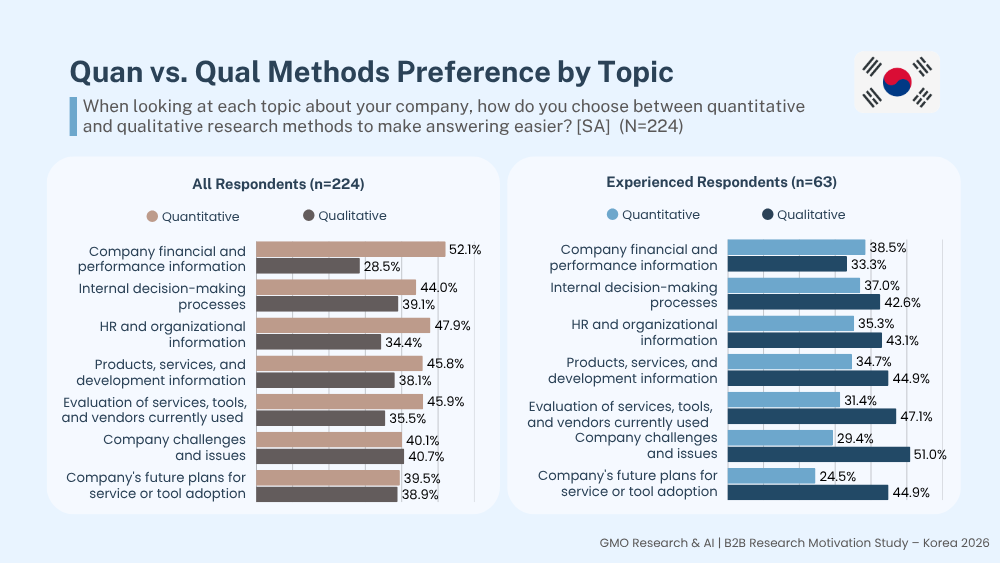
A different tendency is shown in the responses from the experienced group. Across almost every topic, experienced respondents consistently favor qualitative surveys; however, when addressing company financial and performance information, the data shows that experienced respondents still feel more comfortable using quantitative methods.
Keys to Making Respondents Feel Safe and Secure
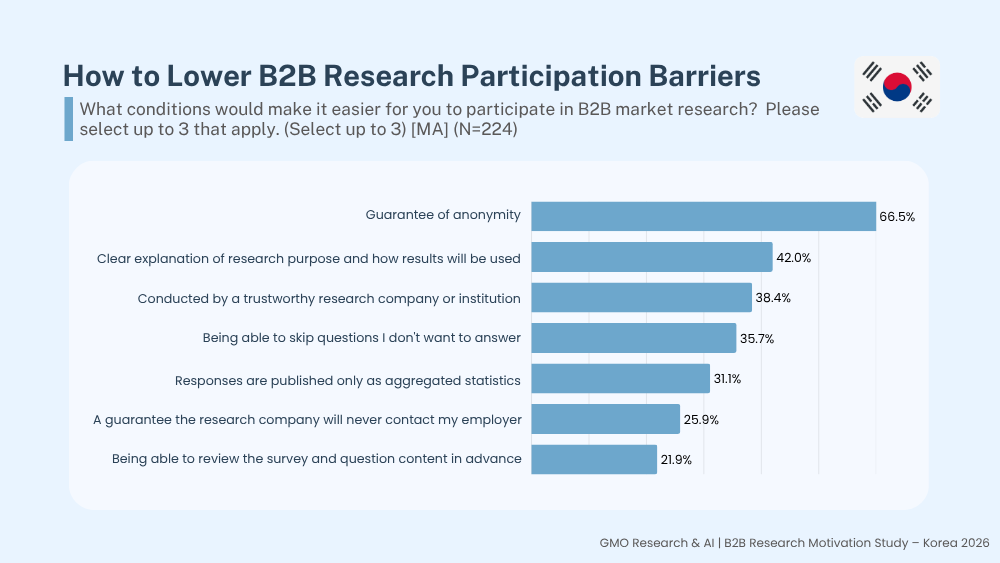
In order to explore more insights of improving engagement in B2B market research, we asked respondents what conditions make it easier for them to participate. Protection of privacy and clarity emerged as top priorities, led by three key factors:
- Guarantee of anonymity - 66.5%
- Clear explanation of research purpose and data usage - 42%
- Oversight by a trustworthy research company or institution - 38.4%
Ultimately, maximizing B2B respondent participation relies on establishing foundational security and legitimacy, as professionals are far more willing to engage when assured of complete personal anonymity, transparent research objectives, and reputable institutional oversight.
Conclusion
Although a majority of the respondents show willingness for participation, concerns surrounding confidentiality and protection of personal information imply that the positivity is not unconditional. Motivating B2B survey participation in Korea requires understanding of respondents’ concern for privacy concerns and their corporate compliance boundaries. While professionals are open to sharing insights to a certain extent, driving engagement ultimately depends on establishing upfront trust through explicit anonymity guarantees and institutional credibility.
At GMO Research & AI, these insights directly shape our data quality strategy. By adjusting for distinct B2B and B2C response behaviors and following international privacy standards, we consistently deliver high-reliability data. Contact our team to power your next B2B research project in South Korea or across the APAC region.

Find out more from our previous contents!
Survey Specifications
 |
Reviewed by: Yukiya Nagata
Executive Managing Director of GMO Research & AI
|
Joined GMO Research & AI in 2011, Yukiya was the domestic sales director of the Japan headquarter until 2016. He then shifted to a new role of managing the global panel and developed online research services in South-East Asia. He also launched the Malaysia office, operating the company as a managing director until 2021. As a board member, his current role involves seeking new business opportunities and partners worldwide.

