

B2B Market Research in Japan: Why Respondent Experience Drives Survey Engagement
2026/07/23
Getting precise data in B2B research is harder than it looks: respondents answer on behalf of their organizations, weighing confidentiality, internal rules, and their own sense of what they can disclose before they reply. This is what actually occurs under a very common B2B fieldwork approach, which recruits respondents based on specific job and organizational profiles from general consumer panels. To see how it plays out in Japan, we surveyed 244 employed professionals in managerial and senior roles. The clearest divide we found came down to experience: whether someone had taken part in B2B research before shaped how much they could answer, how willingly, and how confidently.
Key Takeaways
- Only 20.5% of Japanese professionals have ever participated in B2B research as a respondent.
- Just 31.6% say confidentiality has no impact on their answers; the remainder report a measurable effect.
- 41.8% of non-experienced respondents are unsure of their company's participation rules, versus 4.0% of experienced respondents.
- Across seven business topics, non-experienced respondents are roughly 18–26 percentage points more likely to say they "cannot answer at all."
- The leading conditions that ease participation: guaranteed anonymity (59.0%), the ability to skip questions (50.0%), and a trustworthy research firm (36.5%)
|
For online research in Asia, learn how GMO Research & AI's online panel supports your needs. |
Respondent Profile
The 244 respondents were employed professionals in Japan, weighted toward senior roles.
- Position: 7.0% executives, 14.3% department or division heads, 46.3% managers, and 24.6% team leaders or supervisors, plus 7.8% specialists — over two-thirds in managerial roles.
- Company size: mid-to-large, with roughly 38% at organizations of more than 1,000 employees and about a fifth at more than 10,000; none under 50.
- Experience: only 20.5% (50 of 244) had taken part in B2B research before; the remaining 194 had none. Figures for the experienced subgroup (n=50) are therefore best read as directional.
How Respondents Navigate Confidentiality
We asked respondents how confidentiality affects the way they answer B2B surveys. Only 31.6% reported no particular impact; the rest described concrete effects:
- 42.6% — questions or information they cannot answer
- 27.5% — sometimes keep answers general
- 23.0% — have declined a survey at some point
- 22.5% — have skipped individual questions
In short, respondents actively manage what they share on behalf of their organization. The more useful question is what helps them answer fully and confidently — and here, experience turns out to matter.
Experience Is the Dividing Line for Engagement
Analyzing the responses based on prior B2B research experience highlights three clear differences between experienced and non-experienced respondents. Collectively, these gaps underscore a fundamental theme: prior involvement in B2B research provides respondents with a clear understanding of what they are allowed to answer with confidence.
Gap 1: Experienced Respondents Understand Their Company's Rules
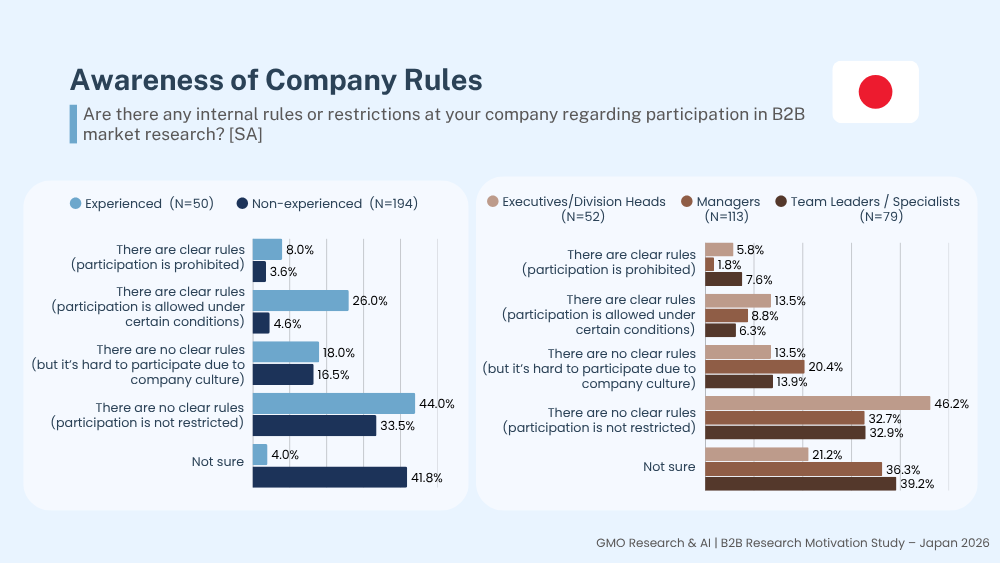
Asked whether their organization has policies on research participation, only 4.0% of experienced respondents were unsure — against 41.8% of non-experienced ones. Experienced respondents know where they stand; most non-experienced respondents have no reference point for judging what they can safely share.
It is also worth noting how seniority factors into this, as prior research experience increases steadily with professional rank:
- Executives / division heads — 36.5% had taken part before
- Managers — 19.5%
- Team leaders / specialists — 11.4%
*Click on the image to expand
Practically speaking, B2B studies generally target senior roles, meaning that recruiting for seniority inherently brings greater rule-awareness. These senior professionals are typically well-versed in company regulations and hold the necessary authority to speak on behalf of the organization.
Gap 2: Experienced Respondents Know How Much They Can Disclose
This knowledge carries directly into the data. Asked how fully they could address seven business topics, non-experienced respondents were far more likely to say they "cannot answer at all" — by roughly 20 to 26 points on the topics where the gap is widest:
- Financial & performance — 32.0% (non-exp) vs 6.0% (exp)
- Products & development — 33.0% vs 10.0%
- Vendor & tool evaluations — 27.8% vs 4.0%
- HR & organizational — 36.1% vs 16.0%
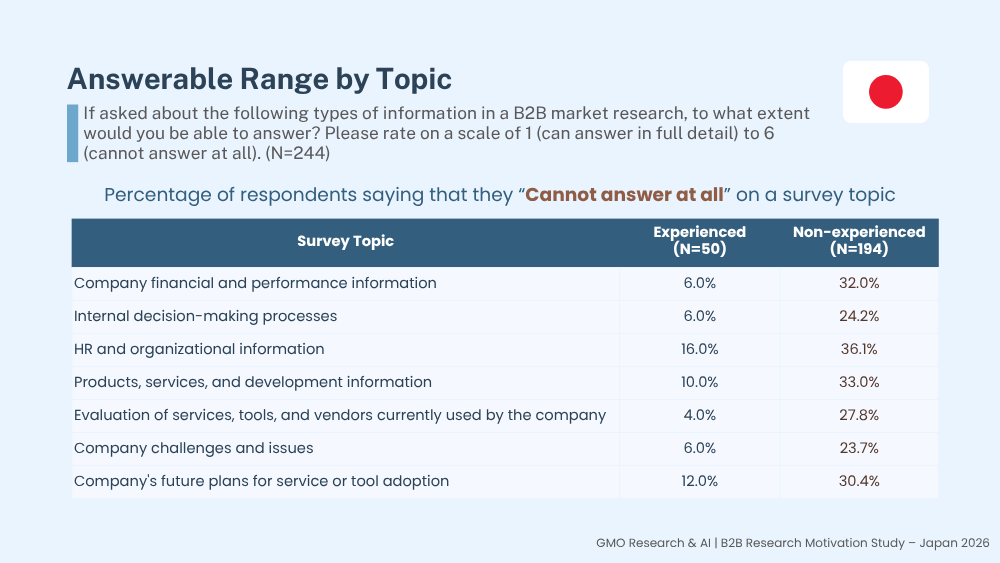
Across every category, experienced respondents were markedly more able to give a substantive answer.
Gap 3: Experienced Respondents Are More Willing to Participate
In terms of willingness in B2B research participation:
- At least somewhat willing — 84.0% (exp) vs 32.5% (non-exp)
- Willing or very willing — 52.0% vs 16.0%
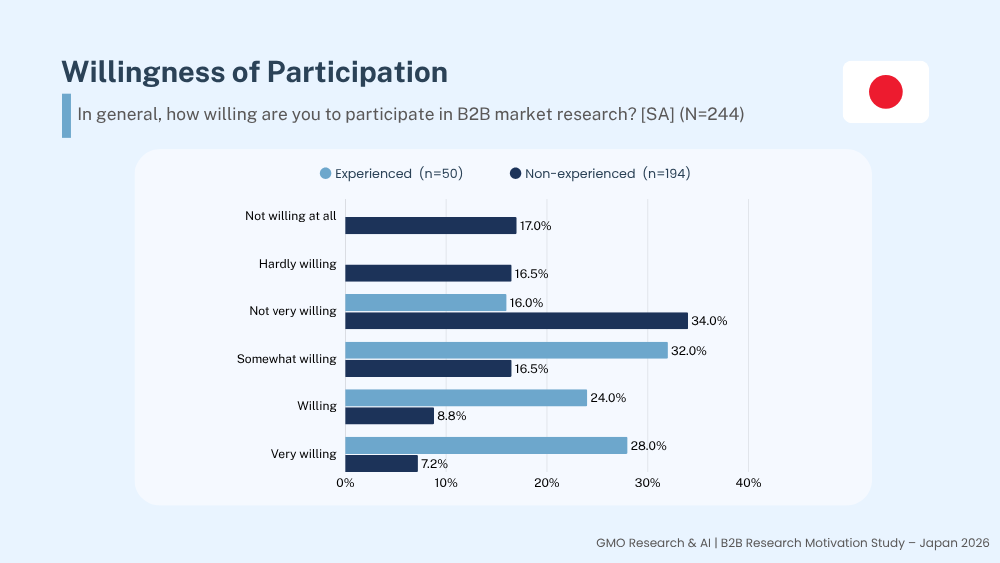
The same held in our 2025 B2B study: 53.9% of experienced versus 24.3% of non-experienced were willing or very willing — almost identical to this year's 52.0%, a stable and repeated finding. However, this causal relationship requires caution. Naturally cooperative individuals may simply be more likely to participate, suggesting experience and willingness reinforce each other.
It is also worth highlighting that the willingness of experienced respondents does not stem from a lack of risk awareness. When questioned about their primary hesitations for participation, those with prior research experience actually expressed a greater concern regarding data leaving the firm compared to their non-experienced counterparts (30% versus 17.5%).
How to Make Participation Feel Secure
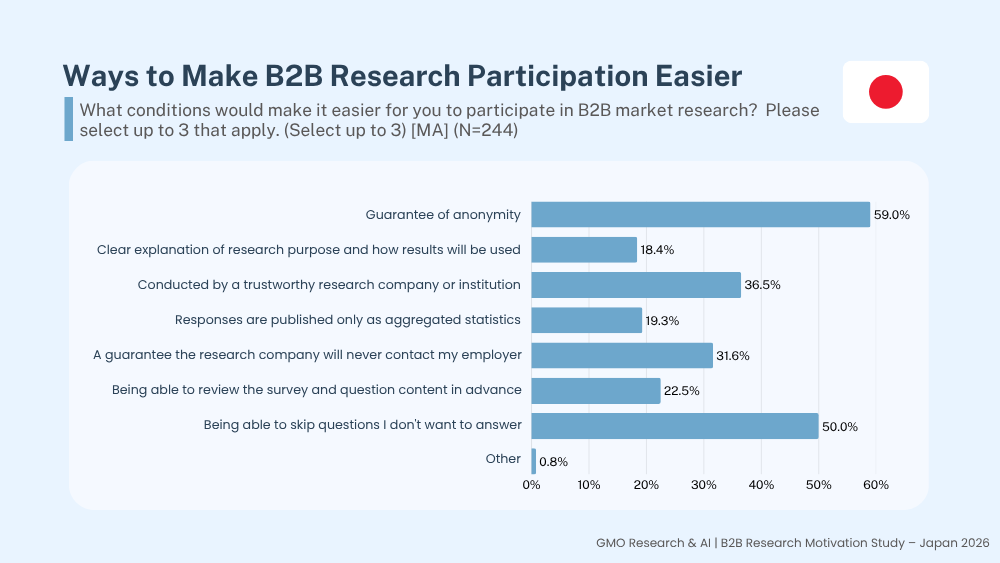
With 79.5% of respondents new to B2B research, the practical question is what makes them feel secure enough to take part and provide answers. Two concerns run through their answers: protecting their organization's confidential information, and protecting their own anonymity. Four conditions came up most often:
- A guarantee of anonymity — 59.0%
- The ability to skip unwanted questions — 50.0%
- A trustworthy research firm running the study — 36.5%
- Assurance of no contact with the employer — 31.6%
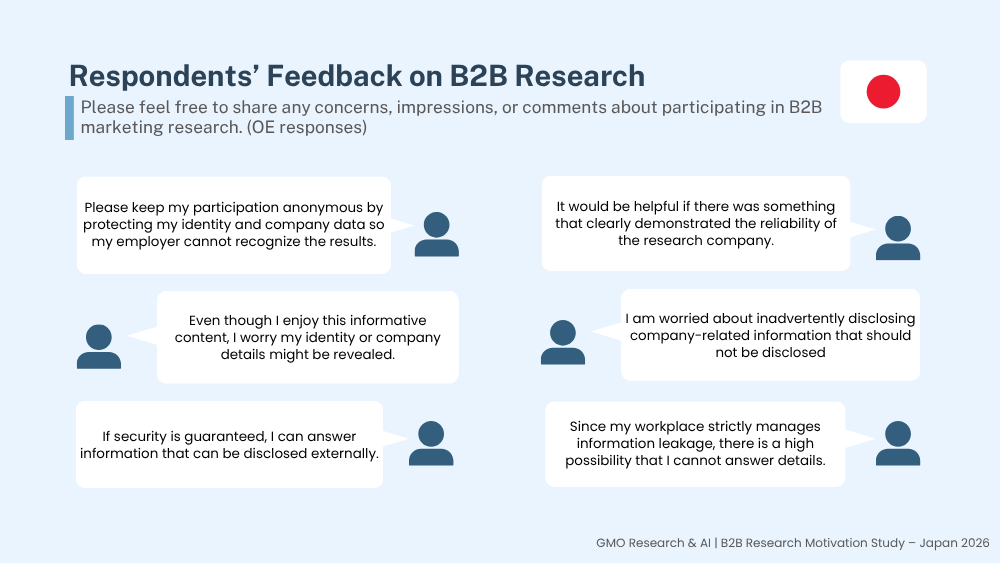
A separate open-ended question, inviting any concerns about taking part, shows what each of these two protections means in practice:
- Protecting the information. Respondents want control over what they disclose: responding only where the information is cleared for external disclosure, and skipping anything sensitive. Some noted their employer manages leakage so strictly that detailed answers may not be possible.
- Protecting the person. Just as important is that no one can tell they took part — that their employer never learns they responded, and that published results cannot be traced back to their company. Anonymity here is about the respondent's own exposure, not only the data.
Underlying both is trust: several would take part only once the provider's credibility was clearly established.
Because these protections matter to respondents regardless of experience, making them explicit is especially valuable for the inexperienced majority: clear safeguards offer reassurance precisely where knowledge of the internal rules is lacking.
Conclusion
What stands out most is how much prior experience shapes not just willingness to respond, but whether people know what they can share at all. For researchers running B2B studies in Japan, that points to two priorities: helping less experienced respondents understand what they can comfortably disclose, and building in the anonymity and control respondents value. Both make studies easier to take part in — and, in turn, higher quality of data.
At GMO Research & AI, insights of this kind inform our approach to response quality: we take account of the differing response tendencies of B2C and B2B participants and support careful handling of sensitive subject matter, in order to deliver more reliable data. If you are planning B2B research in Japan or across Asia Pacific, we would be glad to help.
.png?height=46&width=250)
Find out more from our previous contents!
Survey Specifications
 |
Reviewed by: Yukiya Nagata
Executive Managing Director of GMO Research & AI
|
Joined GMO Research & AI in 2011, Yukiya was the domestic sales director of the Japan headquarter until 2016. He then shifted to a new role of managing the global panel and developed online research services in South-East Asia. He also launched the Malaysia office, operating the company as a managing director until 2021. As a board member, his current role involves seeking new business opportunities and partners worldwide.

