

South Korea Automotive Market Report 2026: A Consumer Survey on Domestic vs. American Brand Perceptions
2026/03/31
Table of Contents
Background of Study
South Korea’s quota limiting U.S. car imports was abolished in 2025 as part of efforts to reduce non-tariff barriers in automotive trade between the two markets. The change could potentially expand market access for U.S. automakers, as vehicles that comply with U.S. safety standards can now enter the South Korean market without a volume cap—previously 50,000 units per manufacturer, now unlimited.
Against this backdrop, GMO Research & AI conducted a study in January 2026 to better understand the current market position of American vehicles in South Korea. The research explores how American car brands are perceived by South Korean consumers in comparison with domestic brands. Analysis focused on key consumer metrics—including brand perceptions, purchase priorities, brand consideration, and ownership evaluations— providing insights into current positioning dynamics and evolving consumer preferences in the South Korean automotive market.
Survey Specifications
Survey Date: Jan 26-30, 2026
Method: Online survey
Target Group: Private car owners/ Private car purchased after 2020/ Intend to purchase a new private car + an extra group of American car drivers
Region: South Korea
Sample Size: 311
Conducted by: GMO Research & AI
|
For online research in Asia, learn how GMO Research & AI's online panel supports your needs. |
Respondent Segment Definition
This study leveraged GMO Research & AI’s automotive online panel in South Korea. The participants, who currently own or plan to purchase a private vehicle, were separated into two distinct analytical segments.
- US Car Non-Considerers (n=163): Consumers who neither own nor plan to purchase an American vehicle.
- US Car Buyers & Intenders (n=148): Consumers who currently own or are considering purchasing an American vehicle.
To ensure sufficient analytical depth, additional profiling quotas were used to secure American-vehicle owners. Consequently, the distribution of American-car owners/intenders in this dataset is not representative of the natural population. Therefore, this article focuses on comparative analysis between the two segments, not market share estimation.
Consumers’ Perceptions on Domestic and American Cars
Key Considerations in Car Purchase: Cost and Safety
*Click on the image to expand
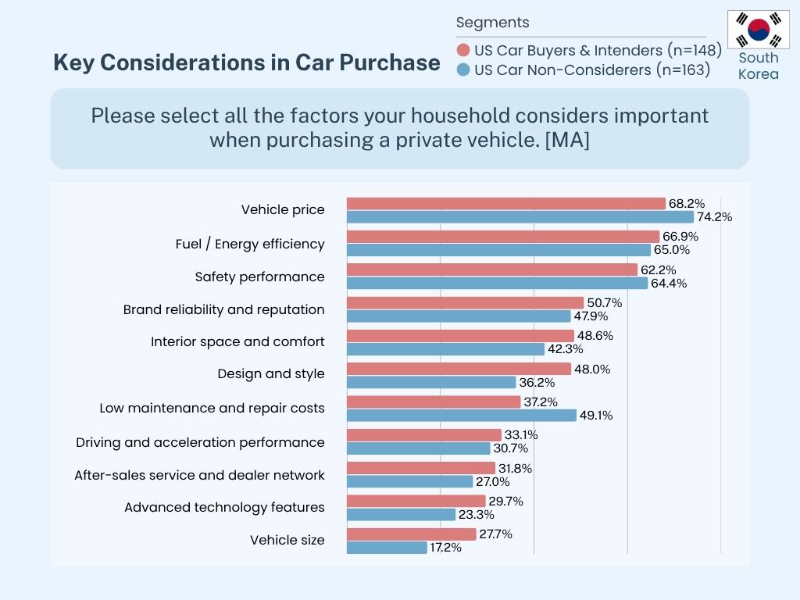
Across both segments, South Korean consumers share highly consistent priorities when purchasing a vehicle. The most commonly cited factors are:
- Vehicle price (68.2% and 74.2%)
- Fuel efficiency (66.9% and 65%)
- Safety performance (62.2% and 64.4%)
However, some secondary differences are notable:
- US Car Buyers & Intenders place greater emphasis on design (11.8 points higher) and vehicle size(10.5 points higher)
- US Car Non-Considerers place greater emphasis on low maintenance and repair costs(11.9 points higher)
The Domestic-American Divide: Functional Value vs. Emotional Appeal
Respondents were asked to rate their impressions of American and South Korean vehicles across multiple attributes in a 6-point scale.
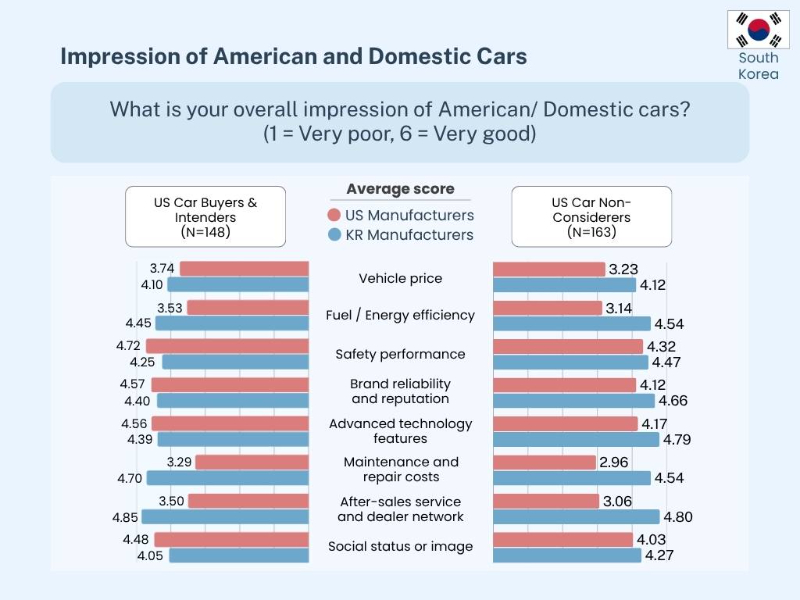
Overall, South Korean vehicles receive higher scores across most attributes, particularly among US Car Non-Considerers. Significant gaps are concentrated in cost and maintenance-related factors:
- After-sales service network (-1.74)
- Maintenance and repair costs (-1.58)
- Fuel efficiency (-1.4)
- Vehicle price (-0.89)
These findings suggest that from the perspective of South Korean consumers, American brands might not yet feel as well-aligned with certain practical needs, as well as crucial purchase criterias such as fuel efficiency and vehicle price indicated in previous questions.
Among US Cars Buyers & Intenders, however, perception gaps narrow significantly. In some areas, American vehicles are rated slightly more favorably, including:
- Safety image (+0.47)
- Status and symbolic appeal (+0.43)
- Advanced technology (+0.18)
- Brand attractiveness (+0.17)
This implies that within the buyers & intenders segment, American vehicles may be evaluated through a different lens—one that places greater weight on perceived distinctiveness and technological positioning.
The Owner's Reality: Measuring Loyalty and Advocacy
To examine how South Korean consumers assess their experiences with domestic versus American car brands, the following analysis focuses on brands with at least 25 owners in the survey: Hyundai (n=182), Kia (n=92), and Tesla (n=25). Due to its smaller sample size, the results for Tesla are interpreted as directional trends.
Owners’ satisfaction
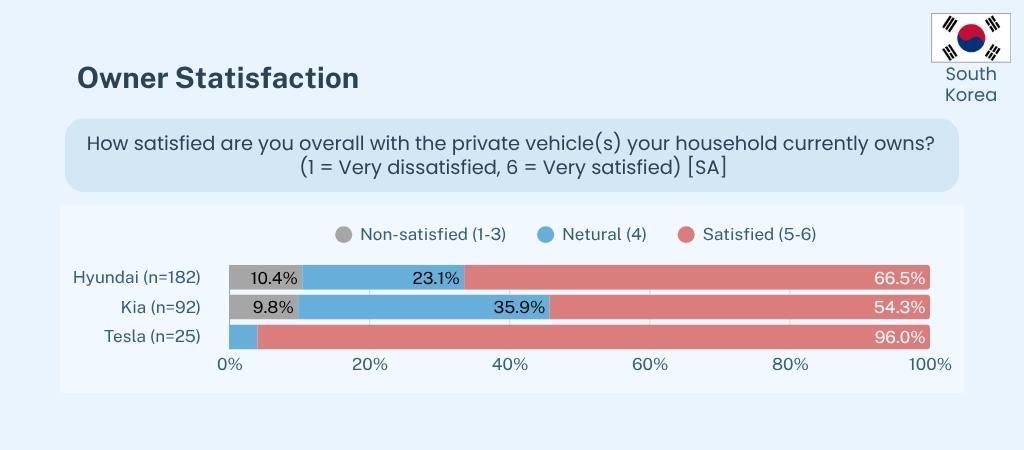
The two main domestic brands, Hyundai and Kia demonstrate solid satisfaction levels with 66.5% and 54.3% of the owners stating satisfaction, though a sizable neutral share suggests moderate enthusiasm. Tesla shows exceptionally high satisfaction of 96%.
Owners’ Advocacy
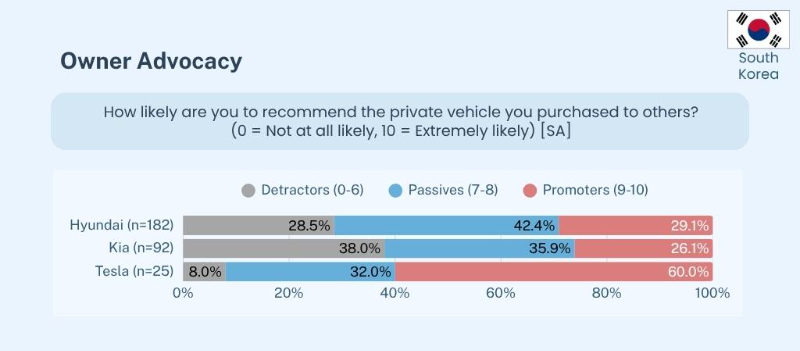
While domestic brands maintain solid satisfaction, this does not fully convert into advocacy. Kia shows a negative NPS (-11.9), indicating weaker recommendation intent. 60% of Tesla’s owners demonstrate strong willingness to recommend.
Owners’ Repurchase Intention
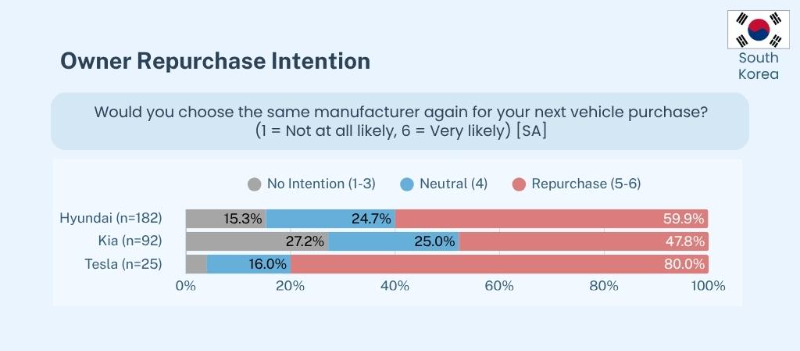
In general, repurchase intention aligns with the current satisfaction level. Hyundai shows stable loyalty with almost 60% wanting to repurchase, while Kia’s repurchase intention is relatively limited. 80% of Tesla owners are likely to repurchase, demonstrating a stronger loyalty compared to the two domestic brands.
Functional and Emotional Attributes Shaping Ownership Experience
The findings could be suggesting a distinction between functional value and emotional value for car purchasing. Domestic brands excel in functional value—price, fuel efficiency, maintenance, and service network—which aligns with core consumer priorities and establishes a baseline for satisfaction.
However, a higher level of satisfaction-advocacy conversion, and also loyalty is often tied to emotional value. American vehicles —particularly within the interested segment—perform relatively better on image and innovation-related attributes. This may help explain why all consumer metrics appear stronger for Tesla, the top-selling American car brand in the South Korean market.
The Impact of Fuel Type Alignment on Brand Consideration
Purchase intention data suggests that interest in American brands is closely linked with powertrain preferences at the segment level. US Car Buyers & Intenders show a notably higher inclination toward EVs compared with US Car Non-Considerers (50.7% vs. 29.6%), while US Car Non-Considerers remain more oriented toward hybrid vehicles (61.7%).
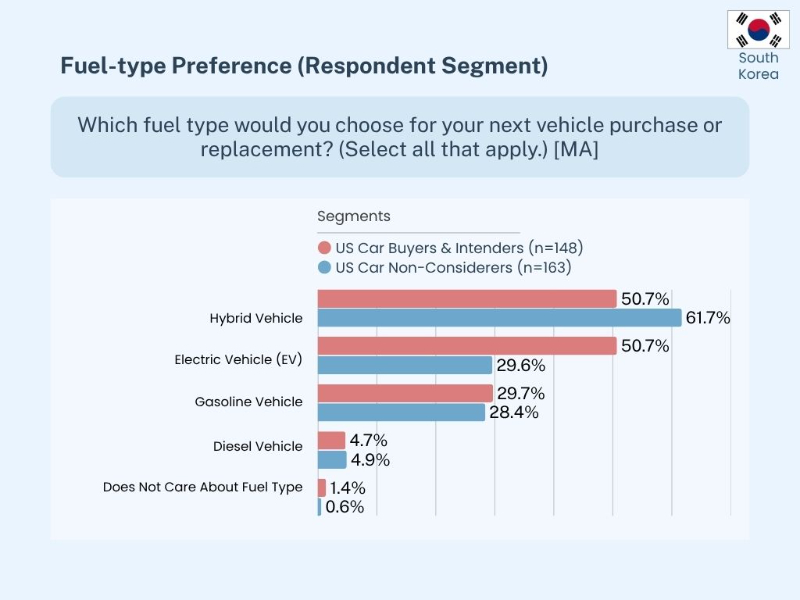
Brand consideration patterns further reinforce this structural divide. Among respondents considering Hyundai or Kia for their next vehicle purchase, hybrid vehicles represent the dominant preference (both around 61%), with EV interest playing a secondary role (33.8% for Hyundai; 49.1% for Kia). In contrast, Tesla consideration is strongly EV-driven, with 66.3% of prospective Tesla buyers indicating an intention to choose an EV.
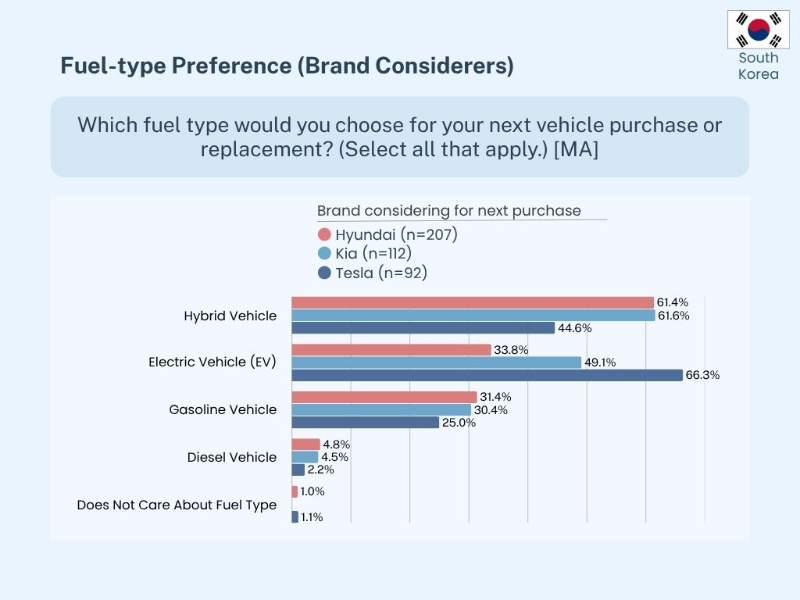
Taken together, these findings suggest that brand-level differences in satisfaction, advocacy, and future demand may partly reflect electrification-oriented consumer segments. Importantly, this pattern appears to be driven by specific EV-aligned brands rather than representing a uniform perception of American vehicles as a whole.
Conclusion
Overall, from this survey result, American vehicles may be positioned more as technology-forward options within specific consumer segments in South Korea.
This positioning could also be viewed together with the context of the South Korean automotive landscape, which is fundamentally a high-barrier, domestically-dominated market where local manufacturers, namely Hyundai and Kia, are already holding extensive market share and anchoring functional excellence and ubiquitous service networks. Consequently, filtered through this domestic lens, American brands are often differentiated as a niche choice.
GMO Research & AI will continue to share original data and insights into the evolving Asian market, and stands ready to assist you to explore latest consumer trends and understand backgrounds of the Asian market.
For a full picture and detailed survey results,
please feel free to download the tabulated data.

Looking for more insights for the Asian Automotive market?
Find out more from our previous studies!
 |
Reviewed by: Yukiya Nagata
Executive Managing Director of GMO Research & AI
|
Joined GMO Research & AI in 2011, Yukiya was the domestic sales director of the Japan headquarter until 2016. He then shifted to a new role of managing the global panel and developed online research services in South-East Asia. He also launched the Malaysia office, operating the company as a managing director until 2021. As a board member, his current role involves seeking new business opportunities and partners worldwide.

