

South Korea Online Survey: 5 Ways to Boost Respondent Motivation
2026/05/20
Table of Contents
Introduction
What determines whether a respondent clicks through a survey invitation, completes it, or quietly moves on? For researchers fielding studies in South Korea, that question has direct implications for data quality and fieldwork efficiency.
To find out, GMO Research & AI surveyed 552 active online panelists in South Korea — asking them directly what drives participation, what causes hesitation, and what leads to dropout. The findings point to five design factors — covering everything from survey length and reward structure to question format and data privacy.
Key Takeaways
- Survey length is the biggest barrier: 81% of South Korean respondents can focus for 10 minutes or less, and it is the top reason for both dropout and hesitation.
- Digital rewards dominate, but vary by generation: Points and electronic money are preferred overall (73.4%), while Gen Z values gift vouchers equally alongside points.
- Audio and video formats face strong resistance: 65% would avoid audio questions and 53% would avoid video — across all generations.
- Privacy concerns are a pre-survey issue: 40.9% cite personal information handling as a hesitation factor, rising to 48.7% among Gen X.
- Topic interest varies significantly by category: Food and beverages score highest (84.4%) while finance and insurance ranks lowest (53.4%) — and low-interest topics require stronger surrounding design.
|
For online research in Asia, learn how GMO Research & AI's online panel supports your needs. |
Respondent Profile
The sample comprised 552 active panelists from GMO Research & AI’s online panel in South Korea — 46.2% male, 53.8% female — spanning Gen Z (21.6%), Millennials (35.3%), and Gen X (43.1%).
All respondents had established survey experience with 54% had completed 20 or more. The majority participate frequently, with 32.1% completing surveys two to three times per week and 23.6% participating nearly every day.
5 Ways to Boost Respondent Motivation in South Korean Online Surveys
What South Korean Survey Respondents Say Matters Most
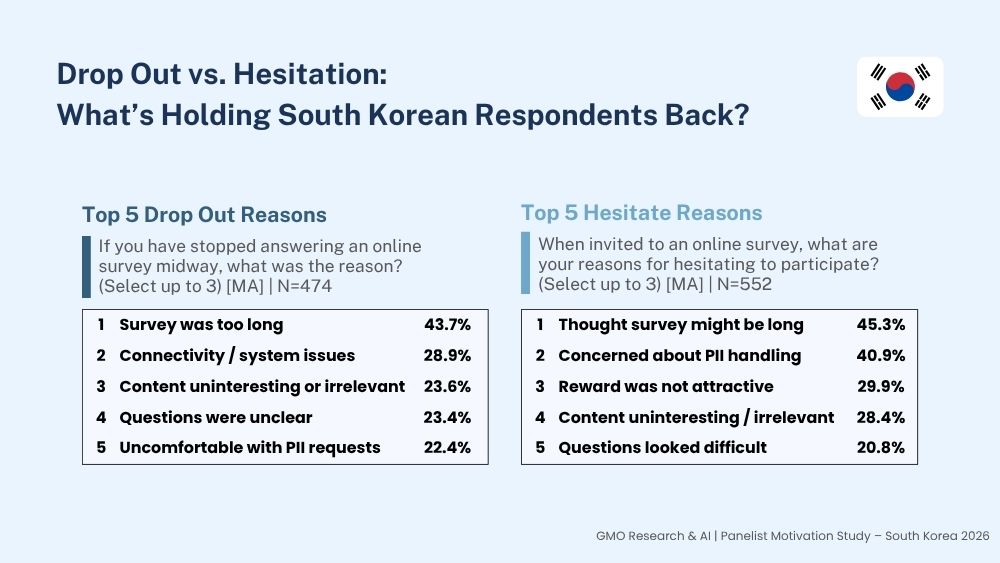
South Korean respondents are not passive participants. Among those surveyed, 85.9% had abandoned a survey before completing it at some point — most commonly because it ran too long (43.7%). Hesitation before starting follows a similar pattern: 45.3% cite length as a concern, and 40.9% point to personal information handling.
*Click on the image to expand
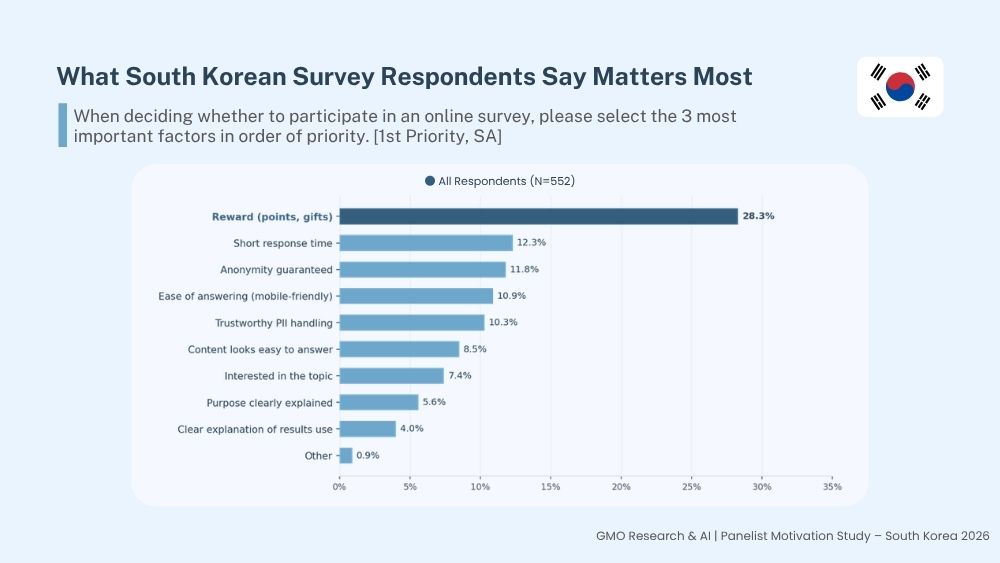
At the same time, the data reveals clear positive drivers. When asked to select their single most important participation factor, respondents most frequently cited reward (28.3%), followed by short response time (12.3%) and anonymity guaranteed (11.8%). The chart below shows the full breakdown across all factors.
Each of these — both the barriers and the motivators — maps directly to one or more of the five practices below.
1.Keep It Under 10 Minutes: Survey Length in South Korea
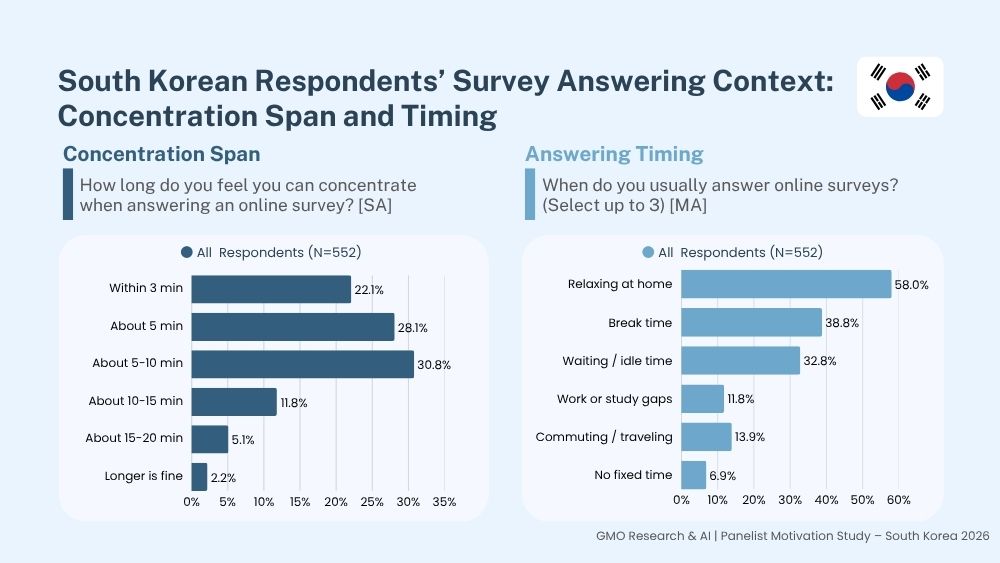
Survey length ranks second among the factors South Korean respondents consider most important when deciding whether to join a survey — and it is also the leading cause of both mid-survey dropout (43.7%) and pre-survey hesitation (45.3%). The concentration data reinforces why: 81.0% of respondents report they can sustain focus for 10 minutes or less — 22.1% within 3 minutes, 28.1% around 5 minutes, and 30.8% between 5 and 10 minutes.
Respondents most commonly complete surveys while relaxing at home (58.0%) or during short breaks (38.8%) — pockets of time, not dedicated sessions — which may help explain why length is so consistently cited as a barrier.
2. Know What South Korean Respondents Want as a Reward
Reward is the top-ranked factor in participation decisions (selected as first priority by 28.3% of respondents). Points and electronic money are preferred overall (73.4%), followed by gift vouchers and coupons (62.9%).
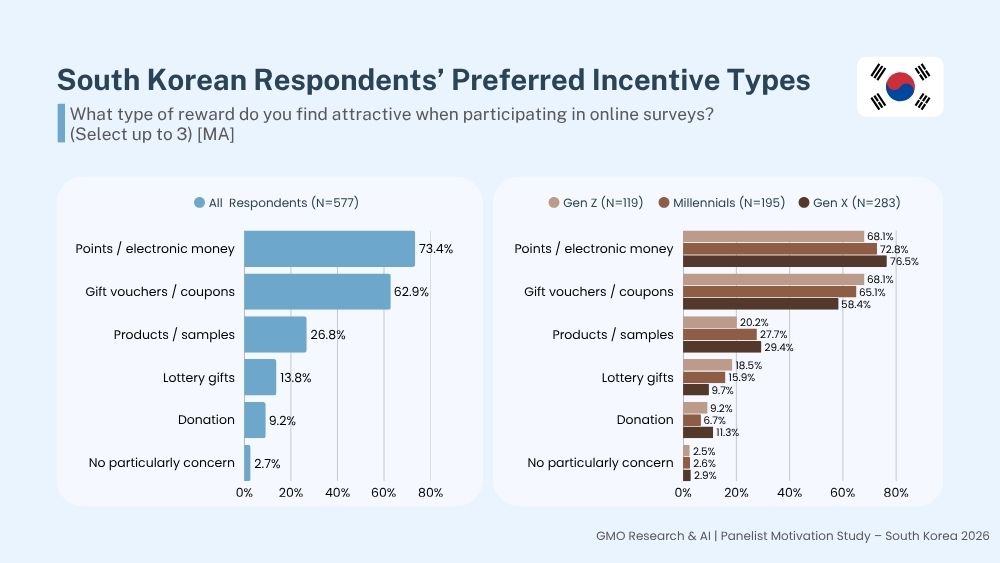
The generational split is worth noting. Among Gen X, points hold a clear lead (76.5% vs. 58.4% for gift vouchers). Among Gen Z, however, the two are tied at 68.1% each — suggesting younger respondents place relatively more value on flexible redemption options. For studies targeting Gen Z specifically, giving gift vouchers equal prominence alongside points may improve appeal.
3. Not All Question Formats Work in South Korea
South Korean respondents show clear preferences by format. Among all the options presented, image evaluation questions attract the most interest (82.2%), followed by grid-style (76.1%) and ranking formats (73.6%). Drag-and-drop or slider questions split exactly 50/50. The chart below shows the full breakdown across all formats.
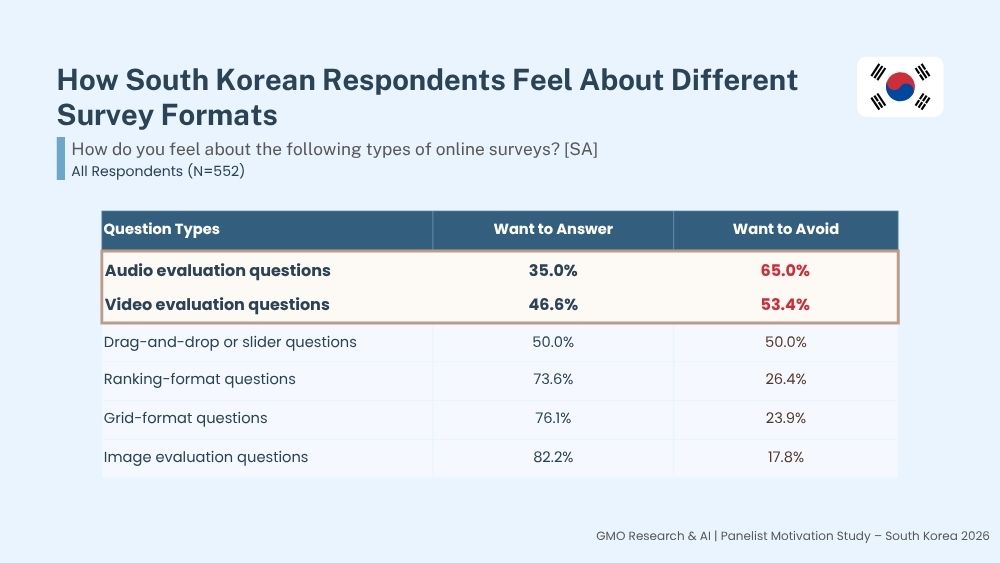
The strongest signal comes from audio and video formats. Overall, 65.0% would prefer to avoid audio questions and 53.4% would avoid video — and these proportions hold across all generations. Where these formats are essential to the research design, positioning them carefully within the survey flow — and offsetting the added burden by reducing length elsewhere — is worth considering.
4. Privacy Concerns Start Before the First Question
Privacy concerns are the second most cited hesitation factor at 40.9% — just behind survey length and well ahead of reward or content concerns. Discomfort with personal information requests was also cited by 22.4% of those who dropped out mid-survey.
The flip side of this is equally telling: anonymity guaranteed ranked third among first-priority participation factors (11.8%), indicating that clear privacy assurance does not just reduce hesitation — it actively motivates participation.
The generational pattern is notable. Gen X respondents are the most cautious about personal information handling (48.7%), followed by Millennials (37.4%) and Gen Z (31.1%) — suggesting privacy sensitivity increases with age in the South Korean context. Communicating data anonymization and the purpose of data collection clearly before respondents commit to participating may meaningfully reduce hesitation, particularly for older segments.
5. Survey Topic Matters: High and Low Interest Areas in South Korea
Topic relevance is a meaningful source of intrinsic motivation: 40.9% of respondents cited the ability to answer topics they find interesting as a reason to participate beyond monetary reward.
Interest levels vary considerably by category. Food and beverages rank highest (84.4%), followed by daily necessities (79.9%) and travel and leisure (79.3%). At the lower end, finance and insurance engages only 53.4% of respondents — the lowest of all categories. Home appliances (60.3%) and automobiles (62.0%) also underperform, with notable demographic gaps: 49.2% of female respondents are not interested in automobiles, and Gen Z disengagement with home appliances reaches 52.9%.
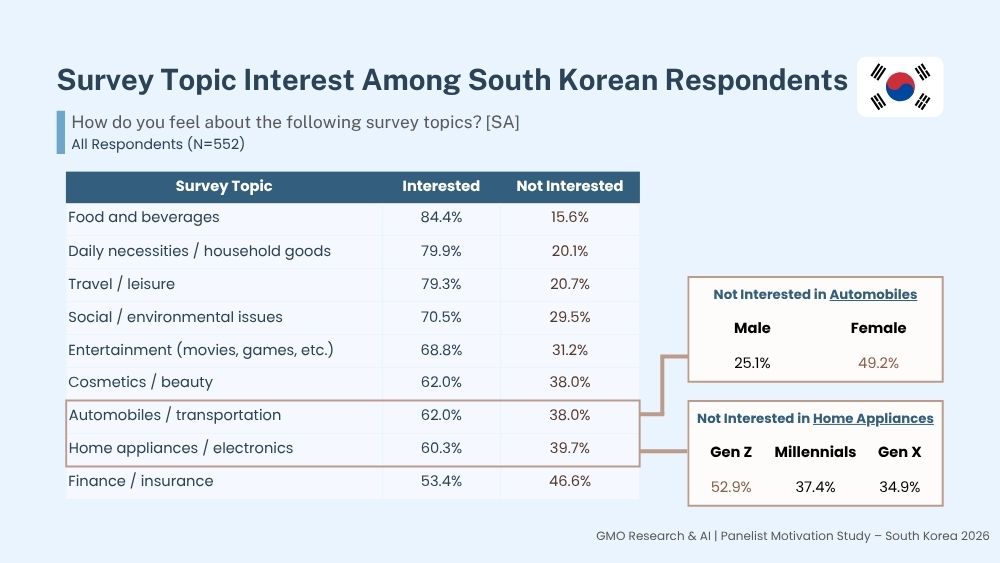
While survey topics may not be within a researcher's direct control, understanding where a topic sits on the interest spectrum provides hints to modifying the surrounding design for themes that carry more of the motivation load.
Designing Better Surveys for South Korea
South Korean survey respondents bring clear expectations to their participation decisions — around time, incentives, format, topic relevance, and data handling. None of these factors operate in isolation. A well-designed incentive structure matters less if the survey is perceived as too long. A relevant topic generates less value if the question format creates friction.
Addressing these five factors in combination gives researchers the strongest foundation for higher engagement, lower dropout rates, and better quality data in the South Korean market.
Survey Specifications
For a full picture and detailed survey results,
please feel free to download the tabulated data.
.png?height=46&width=250)
Interested in learning how to succeed with your survey projects in APAC?
Find out more from our previous contents!
Find out more from our previous contents!
 |
Reviewed by: Yukiya Nagata
Executive Managing Director of GMO Research & AI
|
Joined GMO Research & AI in 2011, Yukiya was the domestic sales director of the Japan headquarter until 2016. He then shifted to a new role of managing the global panel and developed online research services in South-East Asia. He also launched the Malaysia office, operating the company as a managing director until 2021. As a board member, his current role involves seeking new business opportunities and partners worldwide.

